Hãy nhìn xuống đôi bàn tay của bạn. Dưới lăng kính sinh học, đó là một kiệt tác cơ học được tinh chỉnh qua hàng triệu năm. Chính đôi bàn tay ấy, dưới sự chỉ đạo của vỏ não trước trán, đã phác thảo nên những trạm không gian vươn tới các vì sao và viết nên những bản giao hưởng bất hủ. Nhưng cũng chính đôi bàn tay đó, khi bị chiếm quyền bởi hạch hạnh nhân – trung tâm của sự sợ hãi và bản năng sinh tồn cổ đại – có thể kéo cò súng châm ngòi cho những cuộc diệt chủng tàn khốc nhất lịch sử.
Chúng ta luôn tự du ngủ mình bằng một ảo tưởng kiêu hãnh mang tên “Sự tự chủ”. Chúng ta đinh ninh rằng có một vị vua sáng suốt đang ngồi uy nghi bên trong hộp sọ để điều khiển mọi hành vi bằng lý trí thuần túy. Tuy nhiên, sự thật là một cuộc đại phẫu thuật không gây mê vào bản ngã: chúng ta không phải là người cầm lái, mà chỉ là những sinh thể đang vật lộn trong một hệ thống điều hành phức tạp của tiến hóa. Thực tại mà bạn đang trải nghiệm, liệu có phải là một kịch bản được viết vội bởi một tay nhân viên PR tài năng nhưng dối trá ẩn nấp trong nếp nhăn của não bộ?
“Kẻ diễn dịch” – Cái tôi thực chất chỉ là một nhân viên quan hệ công chúng
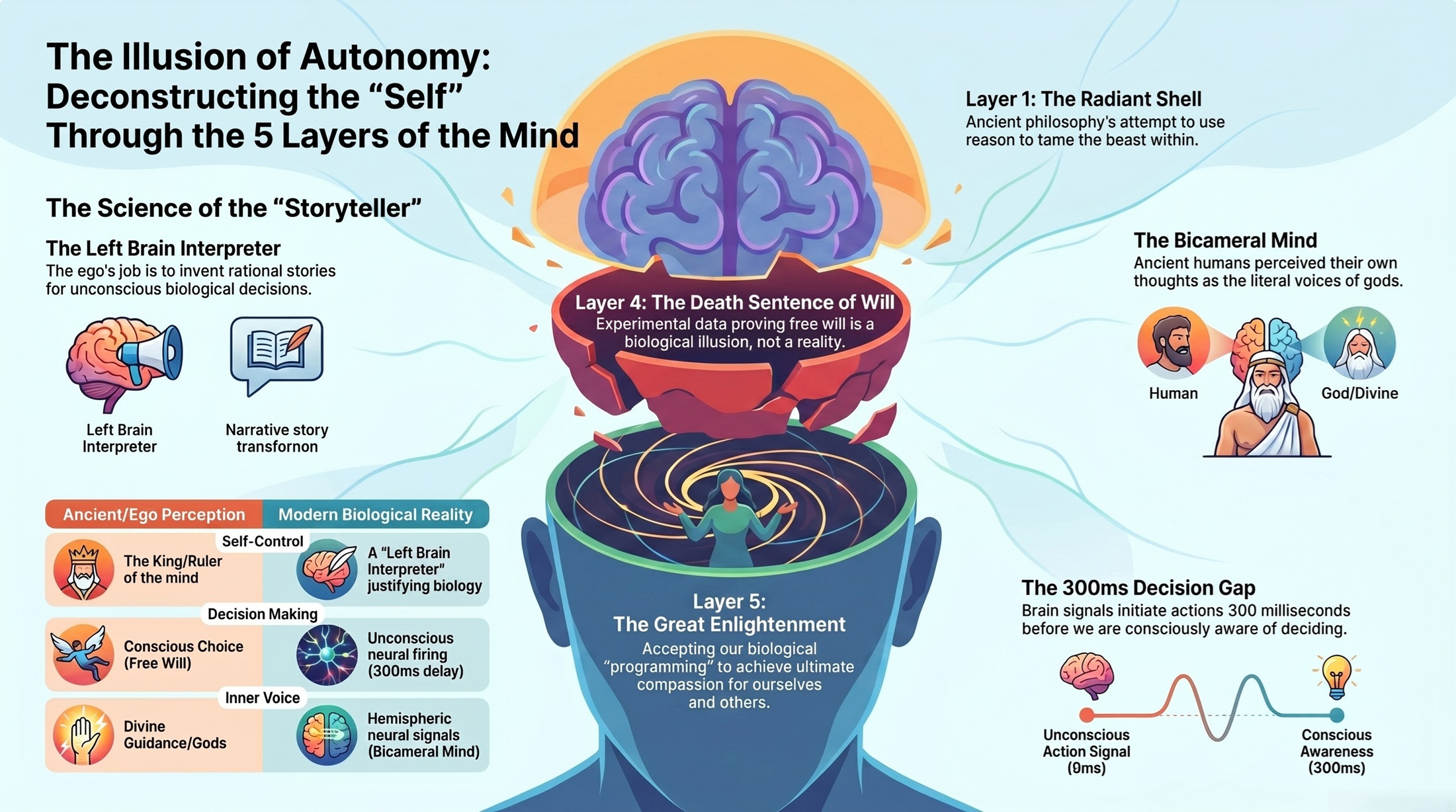
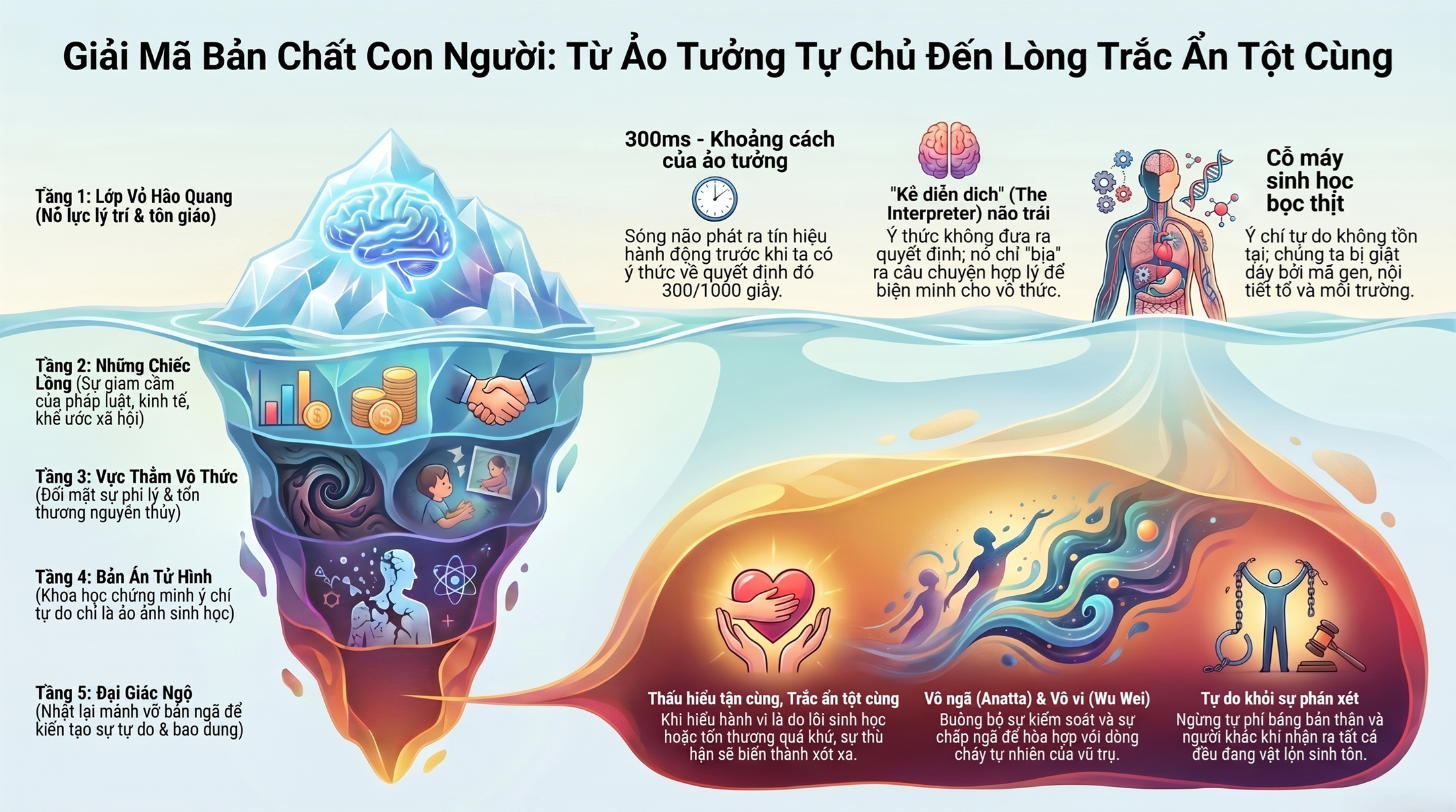
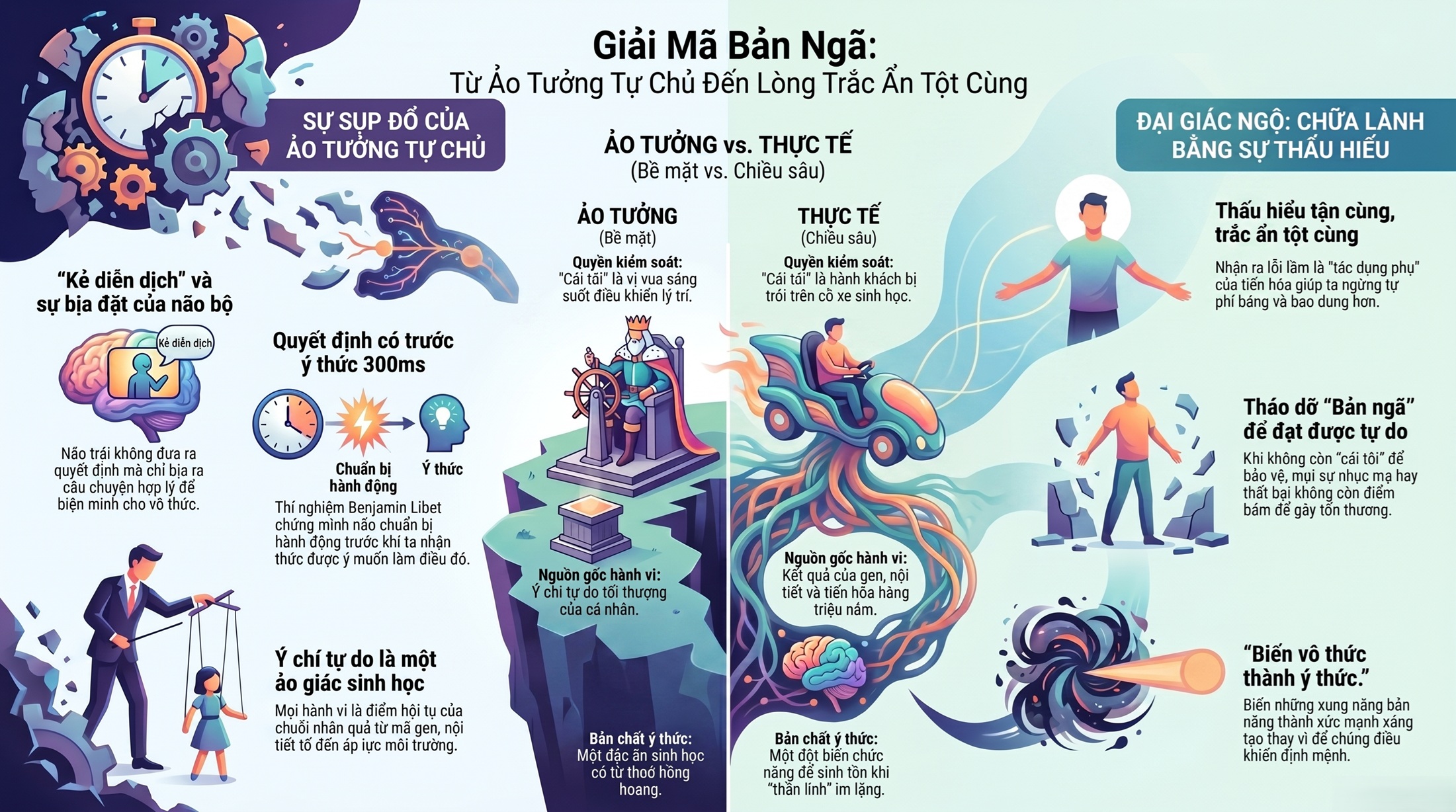
Nhà thần kinh học Michael Gazzaniga, thông qua các thí nghiệm cắt đứt liên kết bán cầu não, đã chứng minh một sự thật làm đảo lộn triết học phương Tây: cái tôi mà bạn tự hào thực chất chỉ là một hệ thống mang tên “kẻ diễn dịch não trái”. Nhiệm vụ của nó không phải là đưa ra quyết định, mà là bịa ra những câu chuyện nghe có vẻ hợp lý để biện minh cho những hành vi mà vô thức và nội tiết tố đã quyết định xong xuôi từ trước.
Thí nghiệm điện não đồ kinh điển của Benjamin Libet vào năm 1983 đã giáng đòn quyết định vào niềm tin này. Kết quả cho thấy sóng não của bạn đã phát ra tín hiệu chuẩn bị cho một hành động trước khi bạn có ý thức về nó khoảng 300 phần ngàn giây.
“Não bộ không hỏi ý kiến ý thức; nó chỉ đơn giản là thông báo cho bạn về một quyết định đã rồi.” — Benjamin Libet.
Ý chí tự do, vì vậy, chỉ là một cái nhãn dán muộn màng lên một quy trình sinh học đã hoàn tất. Cái tôi không phải là vị hoàng đế; nó là gã phát ngôn viên đang nỗ lực giải thích cho những sắc lệnh của một bộ máy vô thức tàn nhẫn.
Tâm trí lưỡng phân – Khi thần linh chỉ là tiếng vang của não phải
Theo học thuyết của Julian Jaynes về “Nguồn gốc của ý thức trong sự đứt gãy của tâm trí lưỡng phân”, con người trước năm 1000 TCN hoàn toàn không có không gian nội tâm hay ý thức như hiện nay. Họ nghe thấy những tiếng nói từ não phải và coi đó là mệnh lệnh trực tiếp của thần linh. Trong sử thi Iliad, các anh hùng như Achilles không hề có “ngã” để đắn đo; họ chỉ hành động theo những ảo thanh quyền uy.
Vào thời đại đó, các từ ngữ chỉ trạng thái tâm lý thực chất dùng để chỉ cơ quan vật lý: thumos (cảm xúc) nghĩa là hơi thở trong phổi, psyche (linh hồn) nghĩa là hơi thở thoát ra từ vết thương.
“Các anh hùng Hy Lạp hoàn toàn vô ngã. Khi Achilles phẫn nộ, đó là do thần linh bơm chất lỏng kích thích vào lồng ngực anh; khi họ chiến đấu, đó là giọng nói của thần Apollo vang lên bên tai và ra lệnh một cách tuyệt đối.”
Ý thức hiện đại thực chất là một “vết sẹo sinh học” nảy sinh sau cuộc khủng hoảng sụp đổ của thời đại đồ đồng. Khi sự phức tạp của xã hội và chữ viết làm câm lặng những tiếng nói thần linh, con người bị đẩy vào một vực thẳm cô độc, buộc não bộ phải phát minh ra một “cái tôi” để tự độc thoại và định hướng sinh tồn.
Trái cấm và bi kịch của sự tự nhận thức
Huyền thoại Vườn địa đàng không đơn thuần là một câu chuyện tôn giáo, mà là ẩn dụ chấn động về sự bùng nổ của vỏ não trước trán (PFC). “Ăn trái cấm” biểu trưng cho khoảnh khắc con người phát triển khả năng thấu hiểu tâm trí, lần đầu tiên nhìn nhận bản thân như một chủ thể độc lập tách rời khỏi tự nhiên.
Sự trần truồng sau khi ăn trái cấm là ẩn dụ cho việc con người nhận ra sự mong manh của cá nhân trước cái chết. Như Darwin từng ghi nhận, con người là sinh vật duy nhất biết “đỏ mặt vì xấu hổ”. Sự lo âu hiện đại chính là “thuế” mà chúng ta phải đóng cho mẹ thiên nhiên để đổi lấy khả năng mô phỏng tương lai. Chúng ta đánh đổi sự bình yên vô thức của loài vật để lấy nỗi kinh hoàng của việc biết trước sự hữu hạn của đời mình.
Vô ngã – Bản ngã không phải danh từ, nó là một động từ
Đối chiếu với khoa học thần kinh, triết học Phật giáo về Vô ngã (Anatman) cho rằng cái tôi thực chất chỉ là một ảo ảnh quang học của não bộ. Tâm trí giống như một cuộn phim nhựa chạy với tốc độ 24 hình/giây, tạo ra ảo giác về một dòng chảy liên tục, nhưng thực tế chỉ là những khung hình tĩnh chớp tắt liên tiếp.
Cấu trúc con người được mổ xẻ qua “Ngũ uẩn”, tương ứng với các xung điện thần kinh nhấp nháy:
- Sắc: Thể xác vật lý và sự trao đổi chất.
- Thọ: Cảm giác (dễ chịu, khó chịu) lướt qua hệ thần kinh.
- Tưởng: Tri giác và sự dán nhãn thế giới dựa trên bộ nhớ.
- Hành: Phản xạ tâm lý, thói quen và xung động.
- Thức: Dòng điện nhận thức bề mặt.
Bạn không phải là một thực thể cố định; bạn là một động từ đang tiếp diễn. “Cái tôi” chỉ là một danh từ thuận tiện để gọi tên sự kết hợp tạm bợ của các linh kiện sinh học đang thay đổi trong từng phần ngàn giây.
Lý trí là nô lệ của đam mê – Khi “gã khổng lồ mù” cầm lái
David Hume từng tuyên bố: “Lý trí chỉ là và chỉ nên là nô lệ của đam mê”. Điều này trùng khớp với học thuyết về Hệ thống 1 và 2 của Daniel Kahneman. Hệ thống 1 (hạch hạnh nhân, phần não cổ xưa) hoạt động nhanh, phi logic và luôn bị cảm xúc giật dây. Hệ thống 2 (vỏ não trước trán) lại vô cùng lười biếng.
Lý trí không phải là vua; nó chỉ là gã thư ký tìm cách hợp lý hóa (rationalize) những bốc đồng của cảm xúc. Chúng ta không suy luận để tìm ra chân lý; chúng ta “cảm” thấy cái đúng bằng bản năng, sau đó mới huy động lý trí để viết nhật ký biện minh cho kẻ cầm lái mù lòa bên trong mình. Con người không phải sinh vật có lý trí, mà là sinh vật giỏi biện hộ cho sự phi lý của chính mình.
Cỗ máy sinh tồn và “Gen vị kỷ”
Nếu cái tôi là ảo ảnh và lý trí là nô lệ, vậy ai thực sự là ông chủ? Richard Dawkins và Steven Pinker đưa ra câu trả lời tàn nhẫn: Chúng ta là những “cỗ xe robot khổng lồ” được lập trình để bảo vệ những phân tử ích kỷ mang tên Gen. Chúng ta không sở hữu Gen; Gen sở hữu chúng ta như một phương tiện vận chuyển (vehicle) để duy trì sự bất tử của chúng qua các thế hệ.
Mọi sự hy sinh, tình yêu hay đạo đức thực chất là thuật toán để Gen được nhân bản. Khi một người mẹ hy sinh vì con, đó là Gen đang tính toán để bảo vệ các bản sao của chính nó ở thế hệ tiếp theo.
“Chúng ta là những cỗ máy sinh tồn – những cỗ xe robot được lập trình một cách mù quáng để bảo tồn những phân tử ích kỷ được gọi là Gen.” — Richard Dawkins.
Sự thấu hiểu mang lại lòng trắc ẩn tột cùng
Việc đập tan ảo tưởng về tự chủ không phải để dẫn đến hố sâu của chủ nghĩa hư vô, mà là để kiến tạo một sự bao dung vĩ đại. Khi hiểu rằng mọi khiếm khuyết, lòng tham hay sự ích kỷ của bản thân thực chất chỉ là di sản của hàng triệu năm tiến hóa sinh tồn, ta sẽ ngừng phỉ báng chính mình.
Sự thấu hiểu tận cùng mang lại lòng trắc ẩn tột cùng. Khi nhận ra hành vi của kẻ thù có thể bắt nguồn từ một hệ thần kinh khiếm khuyết hoặc một chấn thương nguyên thủy, sự thù hận sẽ nhường chỗ cho sự xót xa của một người quan sát. Chúng ta không còn là những vị vua tự trị kiêu ngạo, mà là những hành khách cùng chung một chuyến tàu sinh học đầy bất trắc.
Nếu bạn không phải là người thực sự cầm lái cỗ máy sinh học này, liệu bạn có thể chọn làm một hành khách đầy bao dung đối với chính sinh mệnh của mình?
HÀNH TRÌNH CỦA Ý THỨC: TỪ TIẾNG NÓI THẦN LINH ĐẾN VẾT SẸO SINH HỌC KIÊU HÃNH
SỰ THẬT TÀN NHẪN VỀ “VỊ VUA KHÔNG NGÀI VÀNG”
Hãy nhìn xuống đôi bàn tay của bạn – kiệt tác của hàng triệu năm tinh chỉnh sinh học từ loài linh trưởng. Chính đôi tay này, dưới sự điều khiển của vùng vỏ não trước trán, đã phác thảo nên những bản giao hưởng và các bộ luật nhân quyền vĩ đại; nhưng cũng chính nó, khi bị hạch hạnh nhân chiếm quyền kiểm soát bởi nỗi sợ hãi cổ đại, đã có thể bóp cò súng gieo rắc những thảm kịch khốc liệt nhất. Chúng ta thường tự du ngủ mình bằng một ảo tưởng kiêu hãnh mang tên “Sự tự chủ”, tin rằng bên trong hộp sọ là một “vị vua” sáng suốt đang điều khiển mọi hành vi. Tuy nhiên, khoa học thần kinh hiện đại đã giáng những nhát búa tạ vào ngai vàng đó.
“Ý thức không phải là một đặc ân sinh học gắn liền với loài người từ thuở hồng hoang, mà thực chất là một cơ chế sinh học nảy sinh từ những cuộc khủng hoảng sinh tồn khốc liệt.”
Sự kiêu hãnh về cái tôi độc lập của chúng ta thực chất đang đứng trước 3 cú sốc nhận thức lớn từ khoa học:
- Ảo tưởng về “Kẻ điều hành”: Nhà thần kinh học Michael Gazzaniga đã chứng minh cái tôi thực chất chỉ là một hệ thống mang tên “Kẻ diễn dịch” (The Interpreter) ở não trái. Nhiệm vụ của nó không phải là đưa ra quyết định, mà là bịa ra những câu chuyện nghe có vẻ hợp lý để giải thích cho những hành vi vốn đã được vô thức và nội tiết tố quyết định xong xuôi từ trước.
- Khoảng cách thời gian của ý thức: Thí nghiệm của Benjamin Libet (1983) cho thấy sóng não đã phát ra tín hiệu chuẩn bị cho một hành động trước 300 phần ngàn giây so với khoảnh khắc chúng ta “có ý thức” rằng mình muốn làm điều đó.
- Cỗ máy sinh học bọc thịt: Sự thật lạnh lẽo là bạn không hề quyết định; bạn chỉ được cỗ máy sinh học của chính mình thông báo về một quyết định đã rồi.
Nếu “Cái tôi” hiện tại chỉ là một ảo ảnh được xây dựng muộn màng để bao biện cho bản năng, chúng ta cần quay ngược thời gian 3.000 năm để thấy tổ tiên chúng ta đã vận hành ra sao khi chưa có “tiếng nói nội tâm” này.
THUỞ BÌNH MINH: THẾ GIỚI CỦA TÂM TRÍ LƯỠNG PHÂN (BICAMERAL MIND)
Năm 1976, nhà tâm lý học Julian Jaynes từ Đại học Princeton đã đưa ra một giả thuyết chấn động: Trước năm 1000 TCN, con người hoàn toàn không có ý thức nội quan. Họ vận hành dựa trên một cấu trúc gọi là Tâm trí Lưỡng phân. Trong kỷ nguyên này, hai bán cầu não hoạt động như hai thực thể độc lập, kết nối qua Thể trai (Corpus Callosum) nhưng chưa có sự thống nhất về bản ngã.
|
Tiêu chí
|
Tâm trí Lưỡng phân (Trước 1000 TCN)
|
Ý thức Hiện đại (Sau 1000 TCN)
|
|---|---|---|
|
Nguồn gốc mệnh lệnh
|
Não phải đưa ra chỉ thị, phóng qua Thể trai.
|
Sự hợp nhất chức năng giữa hai bán cầu não.
|
|
Hình thức tiếp nhận
|
Xuất hiện dưới dạng Ảo thính (tiếng nói thần linh).
|
Tiếng nói nội tâm thầm lặng (độc thoại nội tâm).
|
|
Khả năng tự vấn
|
Không có không gian nội tâm để đắn đo, suy nghĩ.
|
Có khả năng nội quan, tự phân tích và lo âu.
|
|
Vai trò của thần linh
|
Thần linh là cơ chế thần kinh điều khiển trực tiếp.
|
Thần linh lui về dĩ vãng hoặc trở thành đức tin.
|
Khi đối mặt với nguy hiểm, não phải sẽ nén tín hiệu và phóng qua Vùng ngôn ngữ não trái. Vì hệ thần kinh chưa đủ tiến hóa để nhận diện đó là tiếng nói của chính mình, họ thực sự nghe thấy một giọng nói uy quyền vang rền từ hư không – tiếng nói của thần linh. Bằng chứng y khoa hiện đại từ Đại học King’s College London đã củng cố điều này: khi sử dụng máy quét MRI trên bệnh nhân tâm thần phân liệt đang nghe Ảo thính, vùng não phải của họ lóe sáng và đẩy tín hiệu sang não trái y hệt cơ chế mà Jaynes mô tả.
BẰNG CHỨNG TỪ XỬ THI HOMER: KHI LINH HỒN CHỈ LÀ CƠ QUAN NỘI TẠNG
Cuộc “giảo nghiệm từ nguyên học” trên xử thi Iliad của Homer phơi bày một sự thật giợn người: trong kỷ nguyên này, không tồn tại từ vựng nào chỉ trạng thái tâm lý hay ý thức. Mọi thứ đều được vật chất hóa một cách trần trụi:
- Sự vật chất hóa tâm hồn: Các từ mà sau này dùng để chỉ tâm linh, lúc đó chỉ là danh từ chỉ cơ quan vật lý. Thumos không phải là cảm xúc, mà là “buồng phổi đang chuyển động”. Psyche không phải linh hồn, mà là “hơi thở” dị máu của chiến binh đang hấp hối.
- Sự vô ngã của anh hùng: Các anh hùng như Achilles hay Hector hoàn toàn vô ngã. Khi Achilles phẫn nộ, văn bản không nói anh ta cảm thấy tức giận, mà mô tả một vị thần đã “bơm một loại chất lỏng kích thích” vào lồng ngực anh ta.
- Mệnh lệnh từ hư không: Các chiến binh không suy tính chiến thuật; họ hành động vì giọng nói của thần Apollo vang lên bên tai và ra lệnh tuyệt đối. Họ là những con rối sinh học xuất chúng dưới sự điều khiển của não phải.
CÚ SỤP ĐỔ THỜI ĐỒ ĐỒNG VÀ SỰ KHỞI ĐẦU CỦA “CÁI TÔI” NỘI TÂM
Khoảng năm 1177 TCN, như giáo sư Eric Cline đã mô tả, thế giới cổ đại đối mặt với thảm họa chuỗi: núi lửa, hạn hán và sự xâm lăng của “Dân tộc Biển”. Sự sụp đổ của các đế chế hùng mạnh đã dẫn đến một cuộc khủng hoảng nhận thức khổng lồ, buộc cấu trúc não bộ phải thay đổi để sinh tồn.
|
Sự kiện lịch sử
|
Tác động nhận thức
|
|---|---|
|
Hỗn loạn & Di cư
|
Con người gặp gỡ những kẻ xa lạ mang theo các “ảo thanh” khác nhau, gây quá tải nhận thức qua Thể trai.
|
|
Sự phổ cập chữ viết
|
Chữ viết ngoại hiện hóa ký ức. Mệnh lệnh khắc trên đất sét khiến “âm thanh” của não phải mất đi quyền uy độc tôn.
|
|
Sự im lặng của Thần linh
|
Giọng nói não phải trở nên nhiễu loạn rồi im bặt, để lại con người giữa vũ trụ câm lặng và hỗn mang.
|
Trong hố sâu của sự tuyệt vọng khi “thần linh im lặng”, não trái đã thực hiện một cú đột biến chức năng: phát minh ra một “không gian nội quan ảo”. Não bộ đẻ ra một bản ngã đại diện – đó là cái tôi – để tự mô phỏng các viễn cảnh hành động trước khi thực thi. Nhân vật Odysseus trong xử thi Odyssey chính là nguyên mẫu đầu tiên của con người có ý thức: anh ta biết nói dối, biết độc thoại nội tâm, biết kìm nén bản năng và đầy mưu mô cá nhân. Ý thức ra đời không phải là món quà êm ái, nó là phản ứng sinh tồn đầy đau đớn để bù đắp cho sự vắng bóng của thần linh.
Ý THỨC LÀ VẾT SẸO SINH HỌC KIÊU HÃNH
Thấu hiểu hành trình này giúp chúng ta nhận ra rằng “Cái tôi” đầy âu lo hiện tại không phải là một khiếm khuyết, mà là huy chương của sự thức tỉnh.
“Ý thức là cái giá của sự độc lập và là tấm huy chương cho một tâm hồn đã thức tỉnh từ đống tro tàn của sự sụp đổ thần kinh khốc liệt nhất lịch sử.”
Dưới đây là những Insight chữa lành dựa trên khoa học nhân chủng học thần kinh:
- Bao dung với sự lo âu: Hội chứng “suy nghĩ quá mức” (overthinking) thực chất là di sản của một cuộc cách mạng thần kinh khốc liệt. Khi thần linh im lặng, não bộ buộc phải tạo ra tiếng nói nội tâm để bảo vệ bạn. Sự lo âu là cái giá cho sự độc lập.
- Thấu hiểu tận cùng, trắc ẩn tột cùng: Khi hiểu rằng những khiếm khuyết, lòng tham hay sự ích kỷ của bản thân và người khác thực chất là tác dụng phụ của hàng triệu năm tiến hóa sinh tồn, sự thù hận sẽ nhường chỗ cho lòng xót xa của một người quan sát.
- Tự do từ sự tỉnh thức: Giải phẫu bản ngã không phải để tiêu diệt tính người, mà là để gột rửa những ảo mộng kiêu ngạo. Biết mình là một cỗ máy sinh học giúp chúng ta kiến tạo một sự tự do và bao dung vĩ đại hơn cho chính giống loài mình.
Hãy bao dung với sự mệt mỏi của chính mình. Việc duy trì sự tỉnh táo của một con người tự do, bản chất của nó đã là một nỗ lực phi thường. Ý thức của bạn chính là vết sẹo sinh học kiêu hãnh của một giống loài đã dũng cảm bước ra khỏi vườn địa đàng vô thức để tự mình định đoạt vận mệnh.
GIẢI MÃ “CÁI TÔI TỰ TRỊ”: TỪ ÁM ẢNH SINH HỌC ĐẾN CHIẾN LƯỢC TỰ HÒA GIẢI HIỆN ĐẠI
Bản chất của Kiệt sức trong Kỷ nguyên Tự trị
Trong bối cảnh tham vấn hiện đại, chúng ta thường chứng kiến những thân chủ kiệt quệ không phải vì thiếu năng lực, mà vì họ đang gánh vác một “ảo tưởng kiêu hãnh”: niềm tin vào sự tự chủ tuyệt đối. Trầm cảm và lo âu ngày nay không đơn thuần là những khiếm khuyết hóa học cá nhân; chúng là hệ quả của một nền văn minh duy lý, nơi con người đinh ninh rằng có một “vị vua” sáng suốt đang điều hành hộp sọ.
Hãy nhìn xuống đôi bàn tay của bạn. Dưới lăng kính tiến hóa, đó là một kiệt tác cơ học được tinh chỉnh qua hàng triệu năm. Dưới sự điều phối của vỏ não trước trán, nó viết nên những bộ luật nhân quyền vĩ đại; nhưng khi bị chiếm quyền bởi hạch hạnh nhân – trung tâm của sợ hãi cổ xưa – nó có thể châm ngòi cho sự tàn sát. Luận điểm trung tâm mà một nhà trị liệu cần truyền tải là: Sự thấu hiểu tận cùng về khiếm khuyết sinh học sẽ mang lại lòng trắc ẩn tột cùng. Khi chúng ta nhận ra mình là những cỗ máy sinh tồn bọc thịt đầy lỗi, áp lực tự trừng phạt sẽ nhường chỗ cho tiến trình tự hòa giải.
Sự hữu hạn sinh học và Sự giải phóng khỏi áp lực tự trị
Khoa học thần kinh không nhằm mục đích tước đoạt ý chí, mà để cung cấp “bằng chứng ngoại phạm” cho những thất bại mà thân chủ đang tự dày vò.
Phẫu thuật cơ chế “Kẻ diễn dịch não trái”
Nhà thần kinh học Michael Gazzaniga đã minh chứng rằng “cái tôi” thực chất là một hệ thống mang tên Kẻ diễn dịch não trái (Left-brain Interpreter). Nhiệm vụ của nó không phải là ra quyết định, mà là “bịa ra” những câu chuyện hợp lý để biện minh cho các hành vi mà vô thức và nội tiết tố đã thực thi trước đó. Hiểu được điều này giúp thân chủ nhận ra: Tiếng nói nội tâm đôi khi chỉ là một kẻ kể chuyện hư cấu đang cố gắng duy trì sự nhất quán trong một hệ thống đầy nhiễu loạn.
Thí nghiệm Benjamin Libet (1983) và Khoảng cách Ý thức
Thí nghiệm của Libet cho thấy sóng não phát ra tín hiệu chuẩn bị hành động trước tận 300 phần ngàn giây so với khoảnh khắc chúng ta có ý thức về quyết định đó. Đây không phải là bản án tử hình cho tự do, mà là sự xác nhận về tính hữu hạn của ý thức. Khi chấp nhận rằng ý thức chỉ là kẻ nhận thông báo sau cùng, thân chủ có thể bắt đầu buông bỏ gánh nặng chịu trách nhiệm tuyệt đối cho những xung năng bản năng.
Bảng so sánh: Niềm tin truyền thống về Tự chủ vs. Thực tế Khoa học Thần kinh
|
Đặc điểm
|
Niềm tin truyền thống về Tự chủ
|
Thực tế Khoa học Thần kinh
|
|---|---|---|
|
Vị thế Cái Tôi
|
Vị vua độc lập, điều hành lý trí.
|
Kẻ diễn dịch, hợp lý hóa vô thức.
|
|
Trình tự Quyết định
|
Ý chí muốn -> Não phát tín hiệu -> Hành động.
|
Não phát tín hiệu -> Ý thức nhận biết -> Hành động.
|
|
Cơ chế Hành vi
|
Ý chí tự do tối thượng.
|
Chuỗi nhân quả sinh học và điều kiện hóa.
|
|
Hệ quả Trị liệu
|
Tự trừng phạt khi thất bại.
|
Lòng trắc ẩn sinh học và sự bao dung.
|
Di sản đẫm máu của Ý thức: Từ Tâm trí Lưỡng phân đến Cái Tôi cô độc
Nỗi lo âu hiện đại không phải là một bệnh lý lỗi thời, mà là một “vết sẹo sinh học” từ cuộc cách mạng thần kinh khổng lồ.
Hệ thống hóa học thuyết Julian Jaynes
Theo Jaynes, trước năm 1000 TCN, con người vận hành theo mô hình “Tâm trí Lưỡng phân”. Bán cầu não phải đưa ra mệnh lệnh dưới dạng ảo thính, và não trái tiếp nhận đó là “tiếng nói của thần linh”.
Sự sụp đổ của thời đại Đồ đồng (khoảng năm 1177 TCN) cùng sự phổ cập chữ viết đã ngoại hiện hóa ký ức, làm các ảo thanh này im bặt. Để sinh tồn trong một vũ trụ câm lặng, não bộ trái đã thực hiện một cú đột biến: phát minh ra “Không gian nội quan ảo” – tức là cái tôi biết suy ngẫm.
Minh chứng Từ nguyên học: Từ Thumos đến Psyche
Sự chuyển đổi này ghi dấu ấn đậm nét trong ngôn ngữ. Trong sử thi Iliad, các từ ngữ chỉ trạng thái tâm lý thực chất là các danh từ chỉ cơ quan vật lý:
- Thumos: Ban đầu chỉ sự chuyển động của buồng phổi (vật lý), sau mới chuyển nghĩa thành cảm xúc.
- Psyche: Ban đầu là “hơi thở” của chiến binh đang hấp hối (sinh học), sau mới được trừu tượng hóa thành “linh hồn” hay tâm trí.
3 hậu quả tâm lý của sự chuyển đổi:
- Sự im lặng của thần linh: Cảm giác bị bỏ rơi, dẫn đến Hội chứng chấn thương tâm lý tập thể của một giống loài mất đi sự chỉ dẫn thiêng liêng.
- Sự ra đời của nội quan: Khả năng độc thoại, biết nói dối và che giấu bản chất (biểu tượng là anh hùng Odysseus).
- Overthinking (Suy nghĩ quá mức): Một di sản sinh tồn, nỗ lực của não bộ nhằm lấp đầy khoảng trống khi các vị thần không còn lên tiếng.
“Tội tổ tông” dưới lăng kính Tâm lý học Tiến hóa
Huyền thoại Vườn địa đàng là ẩn dụ cho bước ngoặt thức tỉnh của vỏ não trước trán.
- Trái cấm và Theory of Mind: Ăn trái cây biết điều thiện ác biểu tượng cho việc phát triển khả năng “Thấu hiểu tâm trí” – nhận thức bản thân là một cá thể độc lập, dễ tổn thương trước cái chết và sự phán xét.
- Nỗi lo âu địa vị (Rousseau): Khi “mắt mở ra”, con người lập tức cảm thấy xấu hổ về sự trần chuồng. Đây là cơ chế tiến hóa (đỏ mặt vì xấu hổ) để ép cá nhân tuân thủ luật lệ bộ lạc.
- Lời nguyền Ý thức: Như Carl Jung cảnh báo, nếu không biến vô thức thành ý thức, nó sẽ điều khiển cuộc đời ta và ta gọi đó là định mệnh. Sự lo âu chính là “tấm huy chương” cho một tâm hồn đã thức tỉnh khỏi trạng thái muông thú vô tri.
Giải pháp từ Phương Đông: Xé toạc bức màn Maya và Vô ngã
Phương Đông cổ đại cung cấp liều thuốc hóa giải sức nặng của cái tôi phương Tây bằng cách nhìn nhận bản chất ảo ảnh của nhận thức.
- Maya và Mạng lưới chế độ mặc định (DMN): Maya không phải thế giới là giả, mà là sự bóp méo của hệ thần kinh. Khoa học hiện đại xác nhận mạng lưới DMN liên tục vẽ ra ranh giới giả giữa “tôi” và “thế giới”. Sự tỉnh thức là nhận ra “tiểu ngã” chỉ là một phần của “đại ngã” vũ trụ.
- Triết lý Vô ngã (Anatta): Con người chỉ là sự chắp vá tạm thời của Ngũ uẩn (Sắc, Thọ, Tưởng, Hành, Thức). Khi tháo rời các thành phần, “chiếc xe” (cái tôi) không tồn tại. Nhận thức này giúp giải tỏa sự chấp ngã và nỗi đau khi các thuộc tính của cái tôi bị xâm phạm.
- Thực hành Vô vi (Wu-wei): Trạng thái “Dòng chảy” (Flow) – nơi thùy trán tạm ngưng hoạt động phán xét, giúp con người hành động mà không tiêu tốn năng lượng của sự gồng ép lý trí, giảm thiểu sự kiệt sức bản ngã.
Những chiếc lồng Hư cấu: Nơi Xã hội còng tay Cái Tôi
Cái tôi hiện đại không chỉ bị giam trong sinh học mà còn trong các cấu trúc xã hội vốn đòi hỏi một “bản ngã hiệu quả”.
- Leviathan và Bàn tay vô hình: Hobbes (Nhà nước) và Adam Smith (Thị trường) tạo ra các hệ thống đóng vai trò như “Kẻ diễn dịch não trái” bên ngoài. Chúng đòi hỏi con người phải duy trì một cái tôi lý trí, tự chủ và luôn hiệu quả để đổi lấy an toàn và của cải. Chính áp lực phải luôn “duy lý” này đã đẩy con người vào trạng thái kiệt sức bản ngã.
- Sự tha hóa theo Marx: Khi con người bị biến thành đinh ốc trong dây chuyền sản xuất, họ tha hóa khỏi sản phẩm, khỏi đồng loại và khỏi chính “bản tính loài” của mình.
- Hang động của Plato trong kỷ nguyên số: Mạng xã hội chính là vách hang hiện đại, nơi chúng ta bị xích cổ bởi những “bóng ma” địa vị và thuật toán. Sự Bất hòa nhận thức nảy sinh khi hình ảnh lý tưởng trên mạng đối chọi với thực tại trần trụi, gây ra những tổn thương tâm lý sâu sắc.
Con đường tự do cuối cùng
Để đạt được sự tự do, thân chủ cần chuyển từ nỗ lực “kiểm soát” sang nỗ lực “hiện thực hóa” tiềm năng bản thân, giống như triết lý Hạt sồi (Acorn) của Aristotle: Dù ta là một cỗ máy sinh học, ta vẫn mang trong mình một Telos (đích đến) để hưng thịnh.
Sơ đồ Quy trình Tự hòa giải
- I. Chấp nhận Khiếm khuyết (Biological Humility)
- Hệ quả: Giải trừ sự tự trừng phạt và mặc cảm tội lỗi “tổ tông”.
- II. Nhận diện Kẻ diễn dịch (Cognitive Distancing)
- Hệ quả: Tách biệt giữa sự kiện thực tế và câu chuyện thêu dệt của não trái.
- III. Buông bỏ Áp lực Kiểm soát (Radical Acceptance)
- Hệ quả: Ngưng trạng thái chiến đấu của hạch hạnh nhân, giảm kiệt sức bản ngã.
- IV. Hướng tới Telos (Aristotelian Flourishing)
- Hệ quả: Chuyển hóa năng lượng từ “sửa chữa lỗi lầm” sang “hiện thực hóa hạt sồi” bên trong.
Chiến lược lâm sàng dành cho Nhà trị liệu
- Giải cấu trúc nhãn bệnh lý: Giải thích rằng lo âu là “thuế tiến hóa” của một bộ não có nhận thức, không phải là sự hỏng hóc cá nhân.
- Thực hành Khiêm nhường nhận thức: Khuyến khích thân chủ hoài nghi những “câu chuyện” mà não trái bịa ra để bào chữa cho cảm xúc nhất thời.
- Tích hợp Bóng âm (Shadow Integration): Theo Jung, thay vì đè nén phần “con”, hãy nhận diện và chuyển hóa năng lượng bản năng đó thành sức mạnh sáng tạo có kiểm soát.
- Tái lập Khế ước Hiện sinh: Giúp thân chủ nhận diện những “chiếc lồng xã hội” và chủ động tái thương lượng các ưu tiên cá nhân thay vì chạy theo thuật toán đám đông.
- Amor Fati (Yêu lấy Định mệnh): Theo Nietzsche, hãy dạy thân chủ không chỉ chấp nhận mà hãy yêu cả những khiếm khuyết và nghịch cảnh, vì chúng là chất liệu rèn giũa nên sự vĩ đại của riêng họ.
Mục tiêu của cuộc đại phẫu thuật bản ngã này không phải để tiêu diệt tính người, mà để gột rửa những ảo mộng kiêu ngạo. Khi nhận diện rõ những xiềng xích của sinh học và xã hội, chúng ta không còn là những nạn nhân bất lực, mà trở thành những “hiệp sĩ hiện sinh” đầy bao dung cho chính mình và nhân loại.
Giải Phẫu Bản Ngã: Từ Pháo Đài Lý Tính Phương Tây Đến Sự Giải Thoát Vô Ngã Phương Đông
Khởi Đầu Cuộc Đại Phẫu: Ảo Ảnh Về Sự Tự Chủ
Trong suốt hàng ngàn năm, nhân loại đã tự ru ngủ mình bằng một ảo tưởng kiêu hãnh mang tên “Sự tự chủ”. Chúng ta đinh ninh rằng có một “cái tôi” – một vị vua sáng suốt độc lập ngồi bên trong hộp sọ để đưa ra mọi quyết định. Tuy nhiên, khoa học thần kinh và lịch sử nhận thức hiện đại đã giáng một nhát búa tạ đập nát ngai vàng đó.
Trước năm 1000 TCN, theo giả thuyết “Tâm trí lưỡng phân” của Julian Jaynes, con người hoàn toàn không có ý thức nội quan. Các anh hùng trong sử thi Iliad như Achilles hay Hector hành động không phải vì suy nghĩ cá nhân, mà vì họ nghe thấy những “tiếng nói của thần linh” vang lên từ bán cầu não phải. Chỉ sau thảm họa sụp đổ thời đại Đồ đồng (năm 1177 TCN), khi môi trường trở nên quá hỗn loạn, não bộ mới buộc phải tiến hóa để tạo ra một “không gian nội tâm ảo”. Cái tôi, thực chất, chỉ là một công cụ sinh tồn được phát minh muộn màng.
Nhà thần kinh học Michael Gazzaniga gọi thực thể này là “Kẻ diễn dịch não trái”.
“Nhiệm vụ của Kẻ diễn dịch không phải là đưa ra quyết định. Nhiệm vụ của nó là bịa ra những câu chuyện nghe có vẻ hợp lý để giải thích và biện minh cho những hành vi mà vô thức và nội tiết tố đã quyết định xong xuôi từ trước đó.”
Dưới đây là 3 lý do tại sao ý chí tự do chỉ là một ảo giác sinh học dựa trên thí nghiệm kinh điển của Benjamin Libet và quan điểm của Robert Sapolsky:
- Sự chậm trễ của ý thức: Sóng não phát ra tín hiệu chuẩn bị hành động trước 300 phần ngàn giây so với khoảnh khắc chúng ta “muốn” làm điều đó. Ý thức chỉ là kẻ nhận thông báo về một quyết định đã rồi.
- Sự giật dây của sinh học: Mọi hành vi là kết quả của một chuỗi nhân quả kéo dài từ gen, nồng độ hormone buổi sáng, đến những chấn thương ấu thơ và áp lực môi trường. Không có kẽ hở nào cho một “ý chí độc lập” can thiệp.
- Gánh nặng của sự tự trị giả tạo: Việc tin vào cái tôi tự trị khiến chúng ta chịu gánh nặng trách nhiệm tuyệt đối, dẫn đến đại dịch trầm cảm, dằn vặt và văn hóa tẩy chay tàn độc khi ta phán xét lỗi lầm của mình và người khác.
Câu chuyển tiếp: Khi ảo tưởng về một vị vua nội tâm sụp đổ, nhân loại đã chia thành hai ngả đường: phương Tây nỗ lực xây dựng những pháo đài lý tính để kiểm soát nỗi đau, trong khi phương Đông chọn cách tháo dỡ chính người ở trong đó.
Phương Tây và “Pháo Đài Lý Tính”: Xây Dựng Để Đối Mặt Với Nỗi Đau
Triết học phương Tây tiếp cận bản ngã bằng cách sử dụng Lý tính (Reason) như một lưỡi dao để thiết lập trật tự và sự phân biệt.
|
Triết gia / Học thuyết
|
Thế giới quan
|
Công cụ & Mục đích chính
|
|---|---|---|
|
Plato (Thế giới Ý niệm)
|
Thế giới vật chất là “Chiếc hang động” của những cái bóng giả tạo (như ảo ảnh mạng xã hội).
|
Dùng Lý tính để thoát khỏi xiềng xích giác quan, hướng tới sự thật tuyệt đối.
|
|
Aristotle (Định luật Hạt sồi)
|
Vạn vật đều có mục đích luận (Teleology). Con người là “hạt sồi” mang tiềm năng vĩ đại.
|
Hiện thực hóa tiềm năng: Dùng lý tính để đạt trạng thái hưng thịnh (Eudaimonia) thông qua rèn luyện đức hạnh.
|
|
Chủ nghĩa Khắc kỷ
|
Thế giới hỗn loạn và không thể kiểm soát ngoại cảnh.
|
Sự phân đôi quyền kiểm soát: Xây dựng pháo đài nội tâm, chỉ tập trung vào sự phán xét của chính mình.
|
Người phương Tây dùng Lý tính như một tấm khiên. Như Marcus Aurelius đã chỉ ra, chúng ta không bị tổn thương bởi sự vật, mà bởi cách chúng ta nhìn nhận sự vật. Bằng cách rèn luyện kỷ luật của vỏ não trước trán (Prefrontal Cortex) – tương ứng với khái niệm “Lễ” và “Tu thân” của Nho gia – con người tận dụng độ mềm dẻo thần kinh để đứng vững giữa tâm bão.
Câu chuyển tiếp: Tuy nhiên, khi pháo đài lý tính cũng không đủ để ngăn cản sự kiệt sức của việc cố gắng kiểm soát, phương Đông mang đến một giải pháp “giải phẫu” triệt để hơn: bóc tách chính bức màn ảo ảnh đang tạo ra sự chia cắt.
Phương Đông: Bóc Tách Bức Màn May-a và Sự Tháo Dỡ Bản Ngã
Triết học Ấn Độ giáo mang đến khái niệm May-a, một cái nhìn sắc lẹm về cách hệ thần kinh bóp méo thực tại.
Khái niệm May-a (Bức màn ảo ảnh)
May-a bắt nguồn từ gốc từ cổ có nghĩa là “đo lường” hoặc “chia cắt”. Đây là một sự bóp méo khiến thực thể duy nhất và toàn vẹn của vũ trụ bị phân mảnh thành hàng tỷ mảnh vỡ riêng rẽ (tôi và kẻ khác, thiện và ác).
Giải thích đơn giản bằng khoa học
Dưới góc độ khoa học thần kinh, May-a tương ứng với Mạng lưới chế độ mặc định (Default Mode Network). Chức năng của nó là liên tục vẽ ra ranh giới giả tạo giữa “cái tôi” và thế giới để phục vụ mục đích sinh tồn, khiến ta luôn cảm thấy mình là một “con sóng” cô độc sợ hãi cái chết mà quên mình là đại dương.
Ý nghĩa cho người học: Sự thấu cảm bao la
Sự đau khổ nảy sinh khi ta đồng nhất mình với “bản ngã kinh nghiệm”. Khi nhận ra May-a, sự thù hận sẽ biến mất. Làm sao tay trái có thể ghét tay phải khi biết cả hai thuộc cùng một cơ thể? Lòng trắc ẩn lúc này không còn là nghĩa vụ đạo đức, mà là một hệ quả tất yếu của cơ học vũ trụ.
Câu chuyển tiếp: Nếu May-a chỉ ra sự bóp méo của nhận thức, thì thuyết Vô Ngã của Phật giáo chính là lưỡi dao phẫu thuật lạnh lùng nhất để triệt tiêu tận gốc rễ của sự chấp ngã.
Lưỡi Dao Vô Ngã: Khi “Cái Tôi” Chỉ Là Một Danh Từ Tạm Bợ
Đức Phật Thích Ca đã thực hiện một cuộc đại phẫu thuật vào khái niệm “linh hồn vĩnh cửu” thông qua thuyết Vô Ngã (Anatta). Ông khẳng định: không có một kẻ suy nghĩ đứng đằng sau suy nghĩ, không có một người cảm nhận đứng đằng sau cảm giác.
Sử dụng hình ảnh “Chiếc xe ngựa”, Phật giáo chỉ ra rằng cái tên “chiếc xe” chỉ là nhãn mác cho một tập hợp các linh kiện. Bản ngã cũng vậy, nó là một tập hợp tạm bợ của Ngũ uẩn:
- Sắc: Thể xác vật lý (vay mượn và trao đổi chất liên tục).
- Thọ: Những luồng cảm giác lướt qua hệ thần kinh.
- Tưởng: Khả năng tri giác và dán nhãn thế giới dựa trên bộ nhớ.
- Hành: Các phản xạ tâm lý, thói quen và xung động sinh tồn.
- Thức: Dòng điện nhận thức bề mặt nhấp nháy liên tục.
Vô Ngã là một “liệu pháp chữa lành” tối thượng thay vì sự trống rỗng tiêu cực. Khi bạn thấu thị rằng mình không phải là một danh từ cố định mà là một “động từ đang tiếp diễn”, cái bia đỡ đạn mang tên bản ngã sẽ biến mất. Những mũi tên nhục mạ hay thất bại của cuộc đời sẽ xuyên qua khoảng không vô tận mà không thể găm vào đâu để gây tổn thương. Từ đó, tình yêu thương vô điều kiện tràn vào vì ranh giới đã bị xóa bỏ.
Câu chuyển tiếp: Sau khi tháo dỡ bản ngã bằng phân tích phân tử, Đạo giáo hoàn thiện bức tranh bằng nghệ thuật sống buông xả, hòa mình vào dòng chảy vĩ đại.
Vô Vi: Nghệ Thuật Sống Thuận Dòng Và Sự Buông Xả Kiểm Soát
Lão Tử nhìn thấu bi kịch lớn nhất của con người là “căn bệnh nghiện kiểm soát” (Hữu vi). Việc dùng ý chí để uốn nắn thế giới chỉ dẫn đến sự suy kiệt bản ngã (Ego Depletion) và hoảng loạn.
“Thượng thiện nhược thủy” – Bậc thiện cao nhất giống như nước. Nước mềm mại, nương theo địa hình nhưng có thể bào mòn đá cứng. Sức mạnh của nước đến từ việc buông bỏ cái tôi để hòa nhập hoàn toàn vào “Đạo” (Trật tự tự nhiên).
Khoa học nhận thức thế kỷ 21 gọi trạng thái Vô vi (Wu Wei) là Trạng thái Dòng chảy (Flow State). Lúc này, não bộ xảy ra hiện tượng “Tạm ngưng hoạt động thùy trán” (Transient Hypofrontality). Khi cái tôi phán xét ở vỏ não trước trán tạm nghỉ, hành động sẽ tuôn trào tự nhiên, hiệu quả mà không tốn năng lượng gồng ép.
Lợi ích tâm lý của Vô vi cho người trẻ hiện đại:
- Chữa lành sự kiệt sức: Ngừng mang vác thế giới trên vai; cho phép bùn lầy cảm xúc tự lắng xuống thay vì cố vẫy vùng.
- Sức mạnh của sự mềm mỏng: Chấp nhận thực tại không phải là đầu hàng, mà là trí tuệ để nương theo dòng chảy, giúp đạt mục tiêu mà không tiêu tốn sinh lực.
- Sống trong hiện tại: Thoát khỏi sự dằn vặt của quá khứ và lo âu về tương lai (di sản của cuộc cách mạng thần kinh khốc liệt).
Câu chuyển tiếp: Dù là xây dựng “Pháo đài lý tính” hay “Tháo dỡ bản ngã”, điểm chạm cuối cùng của mọi trí tuệ là sự thấu hiểu mang tính cứu rỗi.
Nhặt Lại Mảnh Vỡ Và Kiến Tạo Sự Bao Dung
Hành trình giải phẫu bản ngã cho thấy: Bản ngã chỉ là một ảo ảnh sinh học, một vết sẹo của tiến hóa để giúp loài người sinh tồn. Khi thấu hiểu tận cùng rằng chúng ta và cả những kẻ làm tổn thương ta đều là những cỗ máy sinh học bị giật dây bởi gen và hoàn cảnh, sự thù hận sẽ bốc hơi, nhường chỗ cho lòng trắc ẩn tột cùng.
Dưới đây là 3 “Công cụ tinh thần” thực dụng để sinh viên kiến tạo tự do giữa nỗi đau:
- Quan sát Kẻ diễn dịch (Gazzaniga’s Tool): Nhận diện giọng nói trong đầu chỉ là một “viên thư ký” đang hợp thức hóa cảm giác. Khi bị lo âu, hãy lùi lại và tự bảo: “Đó chỉ là hệ thống não bộ đang phản ứng, không phải là Sự thật.”
- Phân đôi quyền kiểm soát (Stoic Tool): Khi đối mặt với thất bại, hãy tách bạch: Thứ gì thuộc về nỗ lực của ta (hệ thống 2) và thứ gì thuộc về vận mệnh/ngoại cảnh. Chỉ đầu tư năng lượng vào thứ ta có thể kiểm soát.
- Thực hành cú lùi Vô vi (Taoist Tool): Khi stress đến cực hạn, hãy học cách “buông tay”. Để hệ thần kinh tự điều chỉnh thông qua trạng thái Dòng chảy, ngừng phán xét bản thân và chấp nhận sự bất toàn của chính mình.
Sự thấu hiểu bản chất là chìa khóa để kiến tạo nên một sự tự do và bao dung vĩ đại nhất cho chính giống loài mình.
The Ghost in the Machine: Why Your “Self” is a Biological Illusion
Look at your hands. Through the lens of evolutionary biology, they are a mechanical masterpiece, refined over eons of primate adaptation. Under the command of the prefrontal cortex—the seat of our sophisticated cortical architecture—these hands have drafted blueprints for star-bound space stations and penned the most sacred human rights charters.
Yet, when the amygdala—the ancient center of fear and survival—seizes control of the neural circuitry, these same hands pull triggers and ignite fires that consume civilizations.
For three millennia, humanity has been lulled by a proud “illusion of autonomy.” We believe a wise, independent king sits within our skulls, weighing logic to make every decision. However, modern cognitive science has struck a sledgehammer against this throne. We are not the pilots of our lives; we are biological algorithms shaped by genetic sequences and environmental causality.
What follows is a “surgery on the ego.” While a full diagnostic requires an examination of 44 distinct lenses of thought, we will focus here on the foundational pillars—the seven essential stages of dissection required to reveal the machinery beneath our skin.
Your “Self” is Just a PR Agent (The Left-Brain Interpreter)
Cognitive neuroscientist Michael Gazzaniga’s research on split-brain patients revealed a truth that upends Western philosophy: the “I” we take pride in is actually a biological system called the “Left-Brain Interpreter.”
Its function is not to make decisions. Rather, its role is to invent plausible narratives to justify actions that the unconscious mind and hormones have already finalized.
This was confirmed by Benjamin Libet’s seminal 1983 EEG experiments, which delivered a surgical blow to the concept of immediate free will.
The brain signals the preparation for an action 300 milliseconds before the individual has the conscious intent to act.
The reality is clinically cold: you do not decide; you are merely informed of a decision already made by your biological machine. We carry the crushing weight of responsibility for choices actually pulled by the sutures of genetic coding and childhood conditioning.
The “Gods” Were Just Neural Shortcuts (The Bicameral Mind)
According to psychologist Julian Jaynes, ancient humans (pre-1000 BCE) lacked interior consciousness. They did not “think” as we do today. Instead, when faced with a crisis, the right hemisphere transmitted commands to the left, which the individual perceived as an external, authoritative “voice of a god.”
The collapse of the Bronze Age around 1177 BCE and the rise of literacy “killed” these internal gods. As civilizations crumbled and cultures merged, the conflicting “voices” in the head became a survival liability. This traumatic pivot forced the evolution of the modern “I”—an internal virtual space where we simulate scenarios before acting.
This is not merely fringe speculation. Modern medical evidence supports this neural architecture:
King’s College London MRI studies on schizophrenic patients observed the right hemisphere sending signals to the language centers of the left hemisphere during auditory hallucinations, mirroring Jaynes’ theory of the bicameral brain.
Consciousness was not a gift; it was a biological scar, a functional mutation born from the desperate need to survive a silent universe.
Happiness is the Absence of an “I” (The Buddhist Anatta)
As the West labored to birth the modern “I” as a survival tool, Eastern traditions were simultaneously developing methods to dismantle it. They recognized that this new “virtual space” of the ego would become the primary source of human suffering.
The concept of Anatta (No-Self) uses the “chariot” metaphor for dissection. If you remove the wheels, the axle, and the carriage, where is the “chariot”? It is merely a linguistic label for a temporary collection of parts.
Similarly, the “Self” is a label for five aggregate factors—form, feelings, perceptions, mental formations, and consciousness. We suffer because we cling to this illusion of a permanent noun. When we realize there is no solid “I” to protect, there is no “target” for insults or failures to hit. Freedom is the realization that the “Self” is a verb—an ongoing process, not a fixed entity.
The High Price of the “Fruit of Knowledge”
The Myth of Eden serves as a profound evolutionary metaphor for the birth of the prefrontal cortex. The “Fall” represents the biological moment humans developed “Theory of Mind”—the ability to see oneself as an independent subject and anticipate the judgments of others.
When Adam and Eve “realized they were naked,” they experienced the birth of self-consciousness and shame. This is a uniquely human biological milestone.
Charles Darwin noted that humans are the only animals that blush, a “biological scar” of our self-awareness and the fear of social judgment.
This neural revolution brought the “curse” of agricultural anxiety—the ability to worry about next year’s harvest or the inevitability of death. Overthinking is not a modern disorder; it is the evolutionary tax we pay for the ability to predict the future.
You are a Survival Vehicle for Immortal Genes
At its coldest level, Richard Dawkins’ “Selfish Gene” theory posits that we are “robot vehicles” programmed to preserve immortal molecules.
We are giant, lumbering robot vehicles, programmed blindly to preserve the selfish molecules known as genes.
From this perspective, altruism is rarely a purely moral choice. It is driven by “kin selection”—the biological programming to protect those who share our genetic code. When a mother risks her life for her child, she is making a calculated genetic investment to ensure the survival of her own DNA in the next generation.
While this seems cynical, it fosters a profound connection to the “great network of life.” You are a temporary vessel in a billion-year-old journey, part of a vast, interconnected biological legacy that transcends the individual ego.
True Control is an Internal Fortress (The Stoic Boundary)
The Stoics, such as Epictetus and Marcus Aurelius, recognized the limitations of our biological machinery. They proposed the “Dichotomy of Control”: we cannot control external events, our health, or our reputation, but we have absolute sovereignty over our judgment.
This is the “Internal Fortress.” Events are neutral; only our interpretation of them causes pain. A rainstorm is not “bad”; it is merely the movement of air and water. By narrowing our focus to our internal reactions, we reclaim a sense of agency within a deterministic world. We are not hurt by things, but by the view we take of them.
The Wisdom of Doing Nothing (Wu Wei)
As an antidote to the “exhausted ego” of the modern world, the Daoist concept of Wu Wei (Non-action) suggests moving with the natural rhythm of the universe—the Dao. Laozi used the metaphor of water: it is the softest substance, yet it erodes the hardest stone by simply following the terrain.
Modern cognitive science identifies this as the “Flow” state, where the prefrontal cortex—the worrying “I”—temporarily shuts down, allowing for effortless action. When we stop trying to “hustle” and manipulate the world through the sheer force of our exhausted wills, we become more efficient. By letting the “muddy water” of the mind settle, clarity arises on its own.
Compassion through Determinism
We have journeyed through the iceberg of the ego, from the PR agent in our left brain to the “selfish genes” in our cells. This dissection leads us to the conclusion shared by neurobiologist Robert Sapolsky: if we are biological machines shaped by factors we did not choose—genes, environment, and neural circuitry—then our traditional views of praise and blame must shift.
Total understanding brings total compassion. When you realize that your own flaws or a “cruel” person’s behavior are the result of broken circuitry, a fragmented past, or a “biological scar” of evolution, hatred evaporates into the sorrow of an observer.
Determinism is not just a scientific fact; it is a technology for empathy. Knowing that the “Self” is a passenger and not the pilot, how will you treat your own biological machine—and the machines of others—tomorrow? In a world without the illusion of the “I,” only compassion remains.
The Architecture of Modern Burnout: Deconstructing the Autonomous Self through Neuroscience and Philosophy
The Crisis of the Modern Ego
Burnout is not a failure of time management, nor is it merely the exhaustion of the corporate laborer. It is an existential collapse—the inevitable result of a “Great Surgery of the Ego” performed by reality without the mercy of anesthesia. We are currently witnessing a global epidemic of depression, envy, and chronic fatigue rooted in the “myth of autonomy.” For centuries, we have operated under the illusion that a “wise king” sits atop the throne within our skulls, wielding rational, independent control over our destiny.
To treat the modern professional, we must move beyond the platitudes of stress management and enter the realm of existential deconstruction. We must analyze the human condition through a five-tier iceberg of 44 analytical lenses, bridging evolutionary biology and neuro-philosophy. We are a biological paradox: the same hands that phallicly outline space stations and compose symphonies under the direction of the Prefrontal Cortex are the same hands that, when hijacked by the amygdala, pull triggers and ignite genocides. Burnout is the psychological cost of the “burden of the false autonomous self.” By deconstructing the illusion of the “sovereign I,” we shift from a state of self-flagellation to one of clinical reconciliation.
The Biological Fraud: The Left-Brain Interpreter and Libet’s Hammer
Modern neuroscience serves as a surgical sledgehammer to the throne of Western philosophy. The concept of “Free Will,” once the cornerstone of our legal and moral systems, has been exposed as a post-hoc biological fabrication.
The Left-Brain Interpreter Michael Gazzaniga’s research into split-brain patients revealed the existence of the “Left-Brain Interpreter.” This mechanism is essentially a professional liar; its function is not to make decisions, but to fabricate “rational” narratives to justify actions already determined by unconscious impulses and hormonal fluctuations. We do not act because we choose; we choose because we have already acted.
Libet’s Hammer (1983) Benjamin Libet’s experiments provided the coup de grâce to the autonomous self by measuring the precise gap between neural activity and conscious intent.
|
Event Type
|
Timing (Milliseconds)
|
Cognitive Interpretation
|
|---|---|---|
|
Brain Readiness Potential
|
-300ms
|
The biological machine initiates action.
|
|
Conscious Intent
|
0ms
|
The “Self” receives a Biological Notification.
|
|
Physical Action
|
+200ms
|
The action is executed in the material world.
|
The “Right to Choose” is not a primary cause; it is a late-stage notification. For the burnout victim, this realization is transformative: the guilt of “failing to choose better” is a category error. One cannot be guilty for the output of a machine that had already finished its work before “you” were even informed.
The Evolutionary Genesis of the Anxious Ego: Julian Jaynes and the Bicameral Mind
To understand the modern “overthinking” loop (vòng lặp suy nghĩ), we must view consciousness as a “biological scar” from the most violent neurological revolution in history. Julian Jaynes’ theory of the Bicameral Mind suggests that prior to 1000 BCE, humans were not “conscious” in the modern sense.
- The Breakdown: The ancient mind was divided. The right brain synthesized experience and transmitted it as audible “voices of the gods” to the left brain.
- Etymological Proof: In the Iliad, heroes like Achilles lack interiority. The source reveals that ancient Greek terms had no psychological depth: Thumos referred not to emotion, but to “moving lungs”; Psyche was not a soul, but “bleeding breath.”
- The Hero of Consciousness: By the Odyssey, we see the birth of the “interior space.” Ulysses is the first hero who can lie and scheme—the first to possess a “self.”
Modern anxiety is the ghost of those silent gods. When societal collapse and the rise of writing silenced the “voices,” the brain evolved a “Self” to simulate survival scenarios. “Overthinking” is simply the modern brain’s desperate attempt to fill the silence of a dead bicameral world.
The Fall from Eden: A Psychological Autopsy of Shame and Responsibility
The Garden of Eden is a psychological metaphor for the development of the Prefrontal Cortex (PFC) and the subsequent “Evolutionary Original Sin.”
- The Fruit of Knowledge: This represents the emergence of the Theory of Mind—the ability to see oneself as a separate, vulnerable object. “Nakedness” is the ultimate metaphor for this realization. Darwin famously noted that humans are the only animals that blush; this biological proof of Shame serves as an evolutionary mechanism for tribal survival.
- The Curse of Labor: Following Yuval Noah Harari, we see that the Agricultural Revolution forced the brain to live in the “Anxiety of Tomorrow.” Unlike the animal living in the eternal “now,” the conscious human must worry about next year’s harvest.
We carry The Burden of Choice—a heavy psychological tax paid for our awareness of time and death. Burnout is the result of a brain that can no longer sustain the pressure of being its own god.
The Social Cage: From Legalism to the “Anxiety of Status”
During the Axial Age (Kỷ Nguyên Trục) (800–200 BCE), humanity across the globe simultaneously realized the “cruel reality of free will” and sought social cages to contain it.
- Mencius vs. Han Fei: Mencius argued for innate goodness, evidenced by Mirror Neurons (the “Child at the Well” reflex). Conversely, Han Fei’s Legalism viewed humans as “Incentive-based machinery” driven by reward and punishment.
- Rousseau’s Shackles: Jean-Jacques Rousseau critiqued the birth of “Amour-propre” (status anxiety), where our value is determined by the “eyes of the crowd.”
The modern professional’s exhaustion is a “status tax” paid to maintain a perfect Persona (the mask) while suppressing the Shadow (the animal instincts the “Social Cage” demands we hide). Burnout occurs when the biological friction of this suppression becomes terminal.
The Great Unbinding: Maya, Anatta, and the Art of Wu Wei
Eastern philosophy provides the “bio-psychological medicine” for the ego-induced exhaustion of the West.
- Maya (The Veil of Illusion): fMRI scans of the Default Mode Network (DMN) confirm a brain system that draws a false boundary between “self” and “world.” This is Maya—a biological optical illusion.
- Anatta (Non-self): Using the Chariot Metaphor, we see the self as a collection of parts (the Five Skandhas) with no permanent core. Healing comes from the “Atman = Brahman” realization: the “Monster” (burnout) and the “Victim” (the self) are both made of the same dream-stuff.
- Wu Wei (Action without Exertion): In a state of Flow (transient hypofrontality), the anxious Left-Brain Interpreter is silenced. This is the art of Buông bỏ (letting go)—not as passivity, but as the cessation of the ego’s friction against the biological system.
The Great Reconciliation and Biological Compassion
The path forward is a “Great Reconciliation.” We must replace the “Myth of Autonomy” with Biological Compassion, recognizing that our failures and exhaustions are often just “biological taxes” paid to Mother Nature.
The 3-Step Framework for Biological Compassion:
- Recognition: Acknowledge the “44 lenses” of the biological machine. Realize that your “self” is a notification, not a commander.
- Forgiveness: Let go of absolute responsibility for a nervous system shaped by genes, childhood trauma, and evolutionary algorithms. You are a system responding to inputs, not a king failing his subjects.
- Integration: Stop fleeing from the Shadow. Merge the Persona and the Shadow into a unified, authentic whole.
The ultimate cure for the burnout of the autonomous self is “Amor Fati” (Loving one’s fate). When we stop fighting our biological nature and accept the “Great Surgery of the Ego,” we find the only freedom that is real: the freedom of the universe experiencing itself through our eyes. Accept the burden, and the burden vanishes.
THE EVOLUTIONARY BIOGRAPHY OF THE EGO: From the Voices of Gods to the Proud Biological Scar
For millennia, humanity has slumbered under the proud illusion of Autonomy. We envision ourselves as rational monarchs presiding over a marble throne within our skulls, making deliberate, sovereign decisions. However, the cognitive fossil record and modern neurobiology reveal a far more humbling reality. Your “Self” is not a divine spark; it is a biological adaptation—a proud scar carved into our species by the sheer trauma of survival.
The Throne of Glass: Shattering the Illusion of Autonomy
To excavate the origin of the ego, we must first realize that the “King” in our heads is often the last to know what has occurred. Modern neuroscience has delivered a hammer blow to the rational throne, revealing the conscious “I” to be a biological optical illusion.
- The Left-Brain Interpreter: Michael Gazzaniga’s split-brain experiments demonstrated that the left hemisphere acts as an “Interpreter.” Its function is not to command, but to fabricate a logical narrative to justify actions already decided by the unconscious or hormonal systems.
- The 300ms Gap: Benjamin Libet’s 1983 EEG experiments provided the final mercy stroke to free will. He discovered that the brain emits a “readiness potential” to act roughly 300 milliseconds before a person is consciously aware of their desire to move.
The Cold Truth You do not decide your actions; you are merely informed of a coup that has already taken place. The conscious “I” is not the commander-in-chief of the mind; it is merely the press secretary, tasked with explaining the decisions of a biological machine it does not control.
Transitional Sentence: Once we realize that the ‘King’ inside our skull is merely an interpreter of pre-made decisions, we must look back into history to see how this internal voice first emerged.
The Era of the Bicameral Mind: When Gods Spoke Directly to Men
According to Julian Jaynes, the “Self” as a subjective interior space did not exist before roughly 1000 BC. In this era of the Bicameral Mind, the human brain was neurologically fractured, with the two hemispheres functioning as separate entities.
- Divine Auditory Hallucinations: In the ancient brain, the right hemisphere synthesized experience and transmitted instructions to the left hemisphere. To the ancients, these were not “thoughts” but audible, authoritative voices—the literal commands of gods, kings, or the dead.
- The Physicality of the Iliad: Jaynes’s analysis of the Iliad reveals a mind with no “interiority.” Heroes like Achilles or Hector did not “think” or simulate; they reacted. Emotions were not psychological states but physical organ movements. Thumos (emotion) meant the movement of the lungs; Psyche (life force) meant the physical breath of a dying warrior. There was no “inner room” to hide a thought; every impulse was a physical, externalized command.
|
Bicameral Mind (Ancient)
|
Modern Consciousness
|
|---|---|
|
Divine Commands: Action followed “voices” transmitted from the right-brain.
|
Internal Monologue: We engage in silent, introspective self-reflection.
|
|
Physical Terms: Thumos as lungs, Psyche as breath; no “soul” concept.
|
Psychological Terms: Interior concepts like soul, mind, and “Self.”
|
|
Reactive Survival: Immediate response to auditory hallucinations.
|
Internal Space: The ability to simulate and plot before acting.
|
Transitional Sentence: In this ancient state, humans were not autonomous thinkers but highly efficient survival machines following the instructions of their own brain’s right hemisphere.
The Great Fracture: The Bronze Age Collapse and the Birth of “I”
Modern consciousness was not a gift, but a functional mutation born from the “neurological mutiny” of the Bronze Age Collapse (c. 1177 BC).
- Cognitive Overload: As the “domino empires” collapsed under volcanoes, droughts, and the invasions of the “Sea Peoples,” mass migrations forced humans to encounter strangers with different “gods.” The brain could no longer reconcile competing divine voices, leading to a catastrophic cognitive overload.
- The Technology of Literacy: Writing served as the murderer of the gods. By externalizing memory onto clay and stone, the commands of authority became static and visual. The silent text stripped the right hemisphere’s voices of their audible power, forcing the hemispheres to integrate.
- The Birth of the Internal Space: As the gods fell silent, the left brain evolved an “inner space” to simulate future actions—a cognitive fossil record of the integration. This transition is immortalized in the Odyssey; unlike the reactive Achilles, Odysseus is the first “modern” hero—the hero of lies, internal simulation, and calculated deceit.
Transitional Sentence: As the voices of the gods fell silent, a new, anxious voice arose in the void: the ‘Self’.
The Biological Apple: Consciousness as the Burden of Eden
The myth of the Garden of Eden is a profound neurological metaphor for the expansion of the Prefrontal Cortex and the birth of “Theory of Mind.”
- The Fruit of Knowledge: The “Apple” represents the biological explosion of self-awareness. To “eat” of the fruit was to develop the capacity to see oneself as a separate object and to anticipate the evaluations of others.
- The Price of the Apple:
- Shame and the Court of Conscience: Darwin noted that humans are the only animals that blush. Blushing is the biological evidence of the “Court of Conscience.” Shame evolved as a survival mechanism to ensure tribal conformity; to be “naked” is to be exposed to the judgment of the group.
- Mortality Anxiety: By simulating time, we became the only animal capable of perceiving its own inevitable death, transforming life into a race against the clock.
- Moral Responsibility: The ability to simulate “Good and Evil” created a permanent internal judge, leading to the “curse” of perpetual labor and anxiety over future crop failure or social failure.
Transitional Sentence: This expulsion from the mindless peace of the animal kingdom was not a fall into sin, but a leap into the heavy burden of freedom.
Deconstructing the Illusion: Eastern Wisdom and Modern Biology
While Western thought fossilized the idea of an independent ego, Eastern philosophy and modern biology synthesize to reveal that the “Self” is a temporary fabrication.
- Maya and the Default Mode Network: The “Veil of Illusion” (Maya) is the biological equivalent of the Default Mode Network (DMN). The DMN’s function is to create a “false boundary” between “me” and the world for survival, creating the biological optical illusion of a separate “I.”
- Anatta (No-Self) and the Chariot: Buddhism’s Anatta teaches that the “I” is merely a collection of parts—the five aggregates (Skandhas). Like a chariot composed of wheels and axles, the “Self” vanishes when its components (sensations, perceptions, impulses) are disassembled.
- Flow and Wu Wei: Wu Wei (non-action) represents the temporary suspension of the Prefrontal Cortex. In “Flow,” the anxious self is silenced, allowing the biological machine to act in rhythm with the environment.
|
The Independent Self (Western/Hobbesian)
|
The Interconnected Non-Self (Eastern/Upanishadic)
|
|---|---|
|
Separation: The “I” is a distinct entity in a hostile universe.
|
Interconnection: The “Small Self” is a wave; the “Big Self” is the Ocean.
|
|
Control: The struggle for individual autonomy and total responsibility.
|
Flow (Wu Wei): Moving in rhythm with the “Dao”; non-action.
|
|
Anxiety: The fear of the individual ego’s death and isolation.
|
Peace: The realization that the drop of water is never lost; it returns to the sea.
|
Transitional Sentence: Whether we view the self as a cosmic ocean or a collection of flickering neurons, we are left with the reality of our biological heritage.
The Proud Biological Scar
Consciousness is not a divine crown; it is a “proud biological scar”—the tax we pay for our independence from the “voices of the gods.” Our capacity for overthinking and anxiety is not a psychological weakness, but the heavy cost of a survival mechanism that allows us to simulate the future and navigate a silent universe.
Final Takeaways:
- Biological Compassion: Understanding that greed, ego, and fear are evolution’s leftovers—tàn dư of the hunt—allows us to forgive the “original sin” of our biological nature.
- The Illusion of Sovereignty: Recognizing the “Self” as a narrative interpreter, a “press secretary,” reduces the crushing weight of absolute responsibility and guilt.
- The Heroic Effort of Sanity: Your anxiety is the medal of an awakened soul. To maintain the sanity of a free human being in the silence of the gods is a heroic, albeit exhausting, effort.
In the silence of the gods, we have only each other, bound together by the same evolutionary scar that makes us human.
The Great Ego Deconstruction: An Academic Synthesis of Eastern and Western Mental Tools
The Burden of the “Self”
Look at your hands through the lens of evolutionary biology. They are mechanical masterpieces, refined over millions of years. Under the command of the prefrontal cortex, these hands draft symphonies and human rights laws; however, when hijacked by the amygdala—that ancient seat of fear and aggression—they pull triggers and ignite genocides. For millennia, we have operated under the “Illusion of Autonomy,” the prideful belief that a rational “King” sits within the skull, making deliberate choices.
Modern neurobiology, however, has brought a sledgehammer to this throne. The “Self” is not a commander; it is a passenger with a megaphone.
The Biological Erasure of Free Will
- The Left-Brain Interpreter: Neuroscientist Michael Gazzaniga demonstrated that the “Self” is actually a biological module called the “Interpreter.” Its function is not to make decisions, but to fabricate post-hoc narratives that justify actions already decided by unconscious processes and hormonal shifts.
- The 300-Millisecond Gap: Benjamin Libet’s landmark 1983 EEG experiments revealed that the brain emits a “readiness potential” to act 300 milliseconds before the person is consciously aware of their “desire” to move. You do not decide; your biological machine informs you of a decision already made.
- The Burden of Determinism: Robert Sapolsky and other determinists argue that we are essentially “biological machines.” We suffer from depression and guilt because we believe we “could have chosen otherwise,” ignoring the biological “strings” of genetic coding, childhood trauma, and environmental pressure that dictate our every move.
“Until you make the unconscious conscious, it will direct your life and you will call it fate.” — Carl Jung
This biological reality sets the stage for humanity’s historical attempts to either fortify this perceived ego against the storm or dissolve the fortress entirely.
The Western Fortress: Rationality and the Struggle for Order
The Western tradition is defined by the construction of a “Rational Self” designed to domesticate the beast within. This evolution is famously analyzed by Julian Jaynes as a shift from the “Bicameral Mind” to modern consciousness. In the Iliad, heroes do not “think”; they experience auditory hallucinations—the “voices of gods”—which were actually the right hemisphere of the brain communicating with the left.
The Jaynesian Shift: From God-Voices to Internal Monologue
|
Category
|
Bicameral State (Pre-1000 BCE)
|
Conscious State (Post-1000 BCE)
|
|---|---|---|
|
Internal Dialogue
|
Externalized auditory hallucinations (voices of gods).
|
Internalized monologue; the “I” talking to itself.
|
|
Source of Action
|
Divine command (e.g., Apollo commands Achilles).
|
Internal tactical and moral deliberation (e.g., Odysseus).
|
|
Linguistic Markers
|
Organ-based terms: Thumos (moving lungs/energy); Psyche (dying breath).
|
Abstract terms for mind, soul, and subjective consciousness.
|
The Tools of the Fortress
- Plato’s Cave: This allegory describes the pain of “turning toward the light.” We are prisoners mistaking biological “shadows” (sensory data) for reality. Enlightenment is the agonizing ascent to the “Forms”—objective truths beyond the flickering shadows of our senses.
- Aristotle’s Acorn: Aristotle proposed Teleology, the idea that everything has a purpose. Just as an acorn contains the “potential” (the ancient equivalent of DNA) to become an oak, the human must use reason to achieve Eudaimonia (flourishing).
- Stoic Resilience: The Stoics built a “Citadel of the Mind” using the Dichotomy of Control:
- Internal: Our judgments, intentions, and reactions.
- External: Reputation, wealth, and the actions of others.
- By anchoring identity solely in the internal, the ego becomes an invincible fortress against a chaotic universe.
While the West built a lighthouse of reason to navigate the storm, the East questioned the very existence of the sea.
The Eastern Dissolution: Dismantling the Illusion
Eastern traditions identify the ego not as a fortress to be guarded, but as a biological “de-programming” target.
Maya and the Default Mode Network (DMN)
Indian philosophy describes Maya (The Veil of Illusion), where the nervous system creates a division between “Self” and “Other.”
- Biological Synthesis: This aligns perfectly with the Default Mode Network (DMN) in the brain, which maintains the boundary between the body and the world.
- The Metaphor: The ego is a wave on the ocean. It fears “crashing” and ceasing to exist, forgetting that its essence is the Ocean itself (Atman = Brahman).
The Buddhist Scalpel: Anatta (No-Self)
Buddhism uses the Chariot Metaphor: if you remove the wheels, axle, and seat, there is no “chariot.” It is merely a label for a collection of parts.
- The Film Strip Metaphor: The Abhidharma (Buddhist psychology) explains consciousness not as a flow, but as a “Film Strip.” Much like a movie appears continuous at 24 frames per second, the “Self” is an optical illusion created by billions of microscopic “mind-moments” flashing in and out of existence.
The Five Aggregates (Skandhas)
The “Self” is a temporary patchwork of five moving parts:
- Form (Rupa): The physical body and material borrowed from the environment.
- Feeling (Vedana): The nervous system’s raw reaction (pleasant/unpleasant).
- Perception (Samjna): The brain’s labeling of sensory data.
- Mental Formations (Samskara): Habitual impulses and the will to survive.
- Consciousness (Vijnana): The surface stream of awareness.
The Taoist Flow (Wu Wei)
In contrast to Western “Calculated Morality,” Taoism proposes Wu Wei (Non-action).
- Water-like Nature: Highest good is like water; it seeks the low places, adapts to any container, and erodes the hardest stone without struggle.
- Psychological Flow: This is “transient hypofrontality”—the temporary silencing of the self-critical prefrontal cortex to allow for effortless action.
The Mirror of Society: Power, Morality, and Alienation
The ego is shaped by the social “cages” it builds for security.
The Three Dark Lenses
- Machiavellian Realism: The ego as a tool of survival. The Machiavellian Intelligence Hypothesis suggests the brain evolved to be a Fox (to sniff out traps) and a Lion (to frighten wolves). Morality is merely a cloak for the ego’s pursuit of power.
- Hobbesian Leviathan: In a state of nature, life is “nasty, brutish, and short.” The ego surrenders “Absolute Freedom” to the State (the Leviathan) in exchange for “Absolute Security.”
- Marxist Alienation: In modern labor, the ego is “hollowed out” through four levels:
- Alienation from the Product (it belongs to another).
- Alienation from the Process (labor is a repetitive, mindless act).
- Alienation from Species-Being (loss of creative essence).
- Alienation from Others (seeing fellow humans as competitors).
Social Cultivation vs. Social Control
|
Feature
|
Confucianism (Social Cultivation)
|
Legalism (Social Control)
|
|---|---|---|
|
Human Nature
|
Innate Goodness (Ren).
|
Innate Evil/Selfishness.
|
|
Method
|
Ritual (Li) and education.
|
Strict Law (Fa) and Punishment.
|
|
Analogy
|
Water flowing naturally downward.
|
A crushing machine for obedience.
|
The Synthesis: Towards a Great Compassion
The ultimate “Enlightenment” is the synthesis of biological determinism and philosophical dissolution.
The Mirror of Virtue
Mencius argued that compassion is an innate reflex, famously using the example of a child falling into a well. Anyone who sees this feels a sudden “Trắc ẩn chi tâm” (heart of compassion).
- Biological Link: This is the activation of Mirror Neurons. Compassion is not a choice; it is a biological resonance.
3 Primary Benefits of Letting Go of the Ego
- Reduction of Guilt: When you realize your “failings” are biological side-effects of millions of years of evolution, self-flagellation ceases.
- Radical Empathy: Understanding the “Interpreter” allows you to see an enemy’s cruelty as the result of a “malfunctioning nervous system” or a “broken childhood,” rather than “pure evil.”
- Resilience against Failure: If there is no permanent “Self” to protect, social judgments have nowhere to land—they are arrows shot into a void.
Universal Compassion is a byproduct of logic. As Robert Sapolsky suggests, understanding the “strings” of the biological machine leads to the death of hatred.
If the root of all suffering is the false belief that “I” am a separate entity fighting the world, then liberation is the act of tearing down that veil. When you recognize that your “Self” is a biological construct or a spiritual wave on the ocean, the boundary between “I” and “Other” vanishes.
In the ashes of the “Proud Self,” we construct a greatness defined by a vast, biological, and philosophical tolerance for all living things. Understanding all is forgiving all.
Strategic Analysis: The Compassionate Leviathan—Synthesizing Mencius and Han Fei Tzu for Modern Organizational Governance
The Genesis of the Self: From Biologic Survival to Conscious Agency
In the theatre of high-stakes organizational governance, leadership often fails because it addresses behavioral symptoms rather than the underlying neurological substrate of the human condition. Modern workplace conflict is not merely a failure of culture; it is rooted in the neuro-biological transition from instinctual survival to the emergence of the “Interpreter” ego. To manage a workforce is to manage the friction generated when ancient survival mechanisms collide with the modern illusion of autonomous agency.
Deconstructing the Bicameral Mind
The human psyche underwent a radical metamorphosis approximately three millennia ago. As theorized by Julian Jaynes, the pre-modern mind was “Bicameral,” a state where the right hemisphere synthesized experience and transmitted it to the left hemisphere as auditory hallucinations—the “voices of the gods.” Subjective consciousness emerged as a survival adaptation following the catastrophic collapse of the Bronze Age in 1177 BCE, a period of systemic chaos documented by archaeologist Eric Cline. When the voices of the gods fell silent amidst environmental collapse, the brain was forced to internalize a narrative self to navigate complexity. In modern organizations, we see the remnants of this in the “herd mentality” or the paralyzing fear employees feel when top-down directives (the modern voices of gods) disappear.
The Myth of Sovereignty: The Left-Brain Interpreter
The findngs of Michael Gazzaniga dismantle the myth of the rational actor. Through split-brain research, Gazzaniga identified the “Left-Brain Interpreter,” a module designed to manufacture post-hoc rationalizations for actions already initiated by the unconscious. This is corroborated by the 1177 Benjamin Libet (1983) experiment, which proved that the brain’s Readiness Potential (EEG) initiates action 300 milliseconds before the conscious mind “decides” to act. The ego is not the King of the skull; it is a biological mechanism designed to narrate a deterministic script. Organizational creativity and conflict both arise from this “narrative self,” which seeks to justify hormonal and instinctual impulses through the language of professional logic.
The Great Dichotomy: Mencius’ Compassion vs. Han Fei Tzu’s Discipline
The fundamental axis of any management system is its view of human nature. A master strategist must transcend the binary of “good vs. evil” by integrating the “Mirror Neuron” empathy of Mencius with the Nhị bính (Two Handles) logic of Han Fei Tzu. A leader who relies solely on virtue is vulnerable to exploitation; one who relies solely on fear stifles the creative substrate of the organization.
Mencius and the Biological Seed of Virtue
Mencius argued that humans possess the “Four Seeds” of morality: Trắc ẩn (Compassion), Tu ố (Shame), Từ nhượng (Deference), and Thị phi (Right/Wrong). Modern neuroscience validates this through Mirror Neurons, which simulate the states of others within our own nervous system. Empathy is a survival reflex, not a moral choice. A leader must cultivate these seeds through Tu Thân (Self-Cultivation), modeling the behaviors they wish to trigger in their followers’ biological substrates.
Han Fei Tzu and the Deterministic Algorithm
Conversely, the Legalist philosopher Han Fei Tzu viewed human nature as a deterministic algorithm driven by “avoiding pain and seeking gain.” He proposed the Nhị bính—Reward and Punishment—as the original precursor to behavioral conditioning. In a Legalist framework, virtue is secondary to the system; the “Two Handles” ensure that even a mediocre actor produces excellence because the incentives are perfectly aligned with their self-interest.
Strategic Synthesis Table: Confucian vs. Legalist Governance
|
Dimension
|
Confucian (Human-Centric)
|
Legalist (System-Centric)
|
|---|---|---|
|
Primary Motivation
|
Internal virtue & social harmony (The “Four Seeds”).
|
External incentive & self-interest (Nhị bính).
|
|
Control Mechanism
|
Tu Thân (Self-cultivation) & Role-modeling.
|
Pháp (Transparent laws) & Algorithmic rewards.
|
|
View of Human Agency
|
Seeds of Potential (Nurture-dependent).
|
Deterministic Algorithm (Incentive-dependent).
|
|
Risk Mitigation
|
High trust; risk of exploitation.
|
High security; risk of Ego Depletion.
|
The modern leader recognizes that while Mencius identifies the “seed,” Han Fei Tzu provides the “fence.” Virtue flourishes best when contained within a disciplined, transparent system.
The Biological Algorithm: Managing the “Selfish Genotype”
Strategic leadership requires a cold-eyed acceptance that the employee is a “Survival Machine,” as described by Richard Dawkins and Robert Sapolsky. We are governed by the “Selfish Gene” and the dopamine loops of our neurochemistry.
The Burden of the Autonomous Ego
Modern burnout is the “tax” paid to nature for the emergence of the Prefrontal Cortex (PFC). The “Original Sin” of choice forces the PFC to constantly override instinctual impulses, leading to Ego Depletion. The “Compassionate Leviathan” must provide “biological grace” by minimizing the cognitive load on the PFC, allowing the brain to default to safe, structured routines.
Reciprocity in the Digital Environment
In remote or decentralized teams, the lack of physical proximity prevents the firing of Mirror Neurons, leading to a breakdown in organic empathy. Without the “sense of the tribe,” the “Selfish Genotype” defaults to Reciprocal Altruism—a game-theory-based transaction of “I will help only if I gain.” In these digital environments, a reliance on Confucian “virtue-signaling” is a strategic error. Leaders must instead deploy Pháp (Transparent Laws) and clear algorithmic KPIs to provide the structure that biology can no longer provide over a screen.
The Strategic Framework: Building the Compassionate Leviathan
The “Compassionate Leviathan” is an organization that uses iron-clad Legalist systems to ensure fairness and safety while providing a Confucian environment for individual potential.
Implementation of the Two Handles
- Algorithmic Transparency: Design reward systems that satisfy the biological drive for status and survival. By making Nhị bính predictable, you reduce the amygdala-driven anxiety of the “Selfish Genotype.”
- Metacognitive Leadership: Leaders must practice Tu Thân, but with a modern twist. This involves Metacognition—the ability to observe one’s own “Interpreter” ego and biological impulses without being enslaved by them.
Managing Burnout through Taoist “Wu Wei”
We must distinguish between Hữu vi (forced, purposive interference) and Vô vi (non-forced action). Micromanagement is a form of Hữu vi that triggers the Amygdala’s fight-or-flight response, accelerating burnout.
Strategic Directives for Reducing Ego Depletion:
- Eliminate Superfluous Surveillance: Trust the Nhị bính of the system rather than constant Hữu vi. Micromanagement exhausts the Prefrontal Cortex and leads to retention failure.
- Institutionalize Rest Periods: Recognize the “Original Sin” of choice by providing periods of “instinctual recovery” to prevent neurochemical exhaustion.
- Simplification of the Narrative: Use clear, simple objectives to prevent the “Left-Brain Interpreter” from becoming overwhelmed by conflicting rationalizations, which maintains high-performing “Flow” states.
Conflict Resolution and Ethical Fortitude: The Stoic Leader
A leader who cannot manage their own Amygdala is incapable of managing a Legalist system or a Confucian community. They must be the “Internal Fortress” in a world of biological and psychological chaos.
The Scapegoat Mechanism and Mob Psychology
Leaders must be wary of René Girard’s “Scapegoat Mechanism”—the tendency of a team to resolve internal tension by projecting it onto a victim. This “peace through exclusion” is the foundation of modern cancel culture and workplace bullying. A Legalist framework (Pháp) is not merely for efficiency; it is the only barrier against the unconscious violence of the mob. By adhering to transparent laws, the leader protects the individual from being sacrificed to satisfy the group’s biological stress.
Five Non-Negotiable Rules for the Modern Leader
- Acknowledge the Biological Substrate: Never assume an employee acts out of “evil”; assume they are responding to a perceived threat to their survival or status.
- Govern the System, Not the Persona: Use the Nhị bính to manage behavior, leaving the individual’s internal “Seeds” space to flourish.
- Master Metacognition: Observe your own “Interpreter” and Amygdala responses. A leader’s calm is the most potent tool for Mirror Neuron compliance.
- Practice Strategic Vô vi: Intervene only when the natural flow of the organization is blocked; unnecessary Hữu vi is the primary cause of organizational “Noise.”
- Expose the Scapegoat Mechanism: Use Pháp to intervene the moment a team attempts to resolve internal friction through the exclusion of an individual.
The modern leader is both the Architect of the Soul and the Master of the Machine. By synthesizing ancient wisdom with the cold data of neuro-biology, you ensure organizational sustainability in an era of psychological chaos. The Compassionate Leviathan is the only model capable of governing the biological machine that is the human spirit.